Making Sense of Trump v Carney – a Fantasy Thought Experiment

Like many people today, I’m trying to make sense of what’s going on between Trump and Carney. I found inspiration in a short, funky video where two economic thinkers – John Maynard Keynes and Friedrich Hayek – are portrayed as party guests and their competing philosophies are explained in a rap-style battle. One says, ‘People are leaving – turn the music up and keep the party going.’ The other replies, ‘The party itself caused the mess – shut the bar and deal with your hangover.’ That theoretical argument never ended. It just reappeared in modern politics.

Donald Trump talks like the host who refuses to let the party die. If markets wobble, he wants lower rates. If growth slows, he pushes stimulus. If institutions resist, he wants different people in charge. It’s confidence-first and momentum-driven – very Keynesian in spirit.

Mark Carney sounds different. At Davos, he didn’t threaten markets or moralize. He calmly described what happens when rules weaken and trust erodes. Markets didn’t panic – they recalculated. That’s the Hayekian warning in spirit – not ideology, but restraint.

The contrast is simple: Trump promises to keep the party going, while Carney worries about whether the living room floor can take it. But it doesn’t have to be a choice.

Imagine a world where they don’t try to convert each other. Instead, they work together. Trump would create momentum – confidence, investment, urgency, visible growth. Carney would supply the guardrails – calmness, credibility, institutional independence, and boring but trusted rules. Trump supplies energy, Carney supplies stability.

That balance is what I want, and I believe most everyday people want it too: progress they don’t have to constantly worry about. Now for the fantasy – not as a proposal, but as a way of thinking. Let’s call it a thought experiment: clearly unrealistic but revealing.

What if Carney ran the U.S. Federal Reserve? Not literally. Not politically. This isn’t a prediction or a proposal. It’s a way of asking: what kind of system behaviour do people like Carney represent – and why does it feel stabilizing when someone like Trump is around?

In this imagined world, Trump is still Trump. He pushes growth, speed, and visibility. He talks confidently. He absorbs political risk. He doesn’t suddenly become cautious or technocratic. But the Federal Reserve is run by someone with Carney’s instincts. What changes is not ideology — it’s boundaries.

In this fantasy, Trump still says, ‘I want growth.’  The Fed still says, ‘Interest rates are set by data.’ And markets believe both statements at the same time. Carney doesn’t promise lower rates. He doesn’t time decisions to politics. When the data is marginal – could go up, could go down – he defaults to protecting trust, not pleasing anyone.

That behaviour has real effects: markets stop guessing about political interference; long-term interest rates stabilize; fewer sudden mortgage shocks hit households; inflation risk is addressed before it shows up in grocery bills. Nothing dramatic happens. And that’s the point.

Sadly, this is a fantasy – and highly unlikely to go much further than my attempt to make sense of the world today. For the record, I’m still confused and concerned.

Video Credit: Fear the Boom and Bust: Keynes vs. Hayek (2010), created by John Papola and economist Russ Roberts.

PS Real economists would probably argue that it’s not appropriate to describe Trump as purely Keynesian or Carney as purely Hayekian. Neither is pure – but my interpretation of the contrast seems fair, at least for this fantasy experiment.

PPS This article reflects my personal views and is not intended as a political statement, nor does it represent the views of my employer, clients, or any affiliated organizations

Spark followers with respect for a leadership turnaround

Extinguishing leadership behaviour is said to demotivate a team – like putting water on a fire. Whether you study leadership or not that can be a painful thing to observe and worse to experience. The ‘fire inside’ individuals weakens, and the energy level among the team members is drained bit by bit. Sadly, it happens a lot especially when managers are not well suited for the job. Which also happens a lot. In most organizations there are heroes who help the team push past the leadership void. And sometimes there are leadership turn arounds where the extinguishing behaviour is discovered and ended.

In large matrixed professional organizations there can be many leadership successes as well as gaps and inconsistencies. Followers increasingly hold their leaders to account including how leaders carry themselves – how they set the tone. Science suggests good followship in a professional setting involves followers asserting themselves. Good leaders get the message but what happens when they don’t? One possibility is that trust for the leader erodes. A feeling of futility among the followers fuels a leadership death spiral and eventually the leader’s messages fall on deaf ears. When a leader is tone deaf to how their team is feeling about their leadership the team finds a new de facto leader for matters not requiring position authority. Follow-to-rule attitudes develop – kind of like work-to-rule but of the heart and mind not the body. As a leader s/he’s “dead to me” becomes more palpable. It stands to reason in this situation that the team’s performance would decline.

Don’t extinguish. Spark the fire inside (Source: https://alchetron.com/Spark-(fire)).

There’s another narrative that could emerge from a leader’s failure to spark their followers – when leaders who aren’t leading well do get the message from the assertive unhappy professionals. The starting point for this better leadership story is a leader head-shake and acceptance of the likelihood that something’s wrong and its time to eat some humble pie. The key ingredient here is respect.

When leaders become disconnected from the team and followers show signs of declining trust maybe its time for some simple respectful listening by the leader. “You’ve stopped speaking up. We need you to speak up or we’ll lose the customer perspective. I’m not sure I’m giving you what you need or supporting you the way you need right now. What do you need from me as a leader?”

There’s no script for these situations – they’re all different but the starting point is the realization that, its (probably) you leader! Take a deep breathe and respect the years of experience on your team, especially in a professional setting where the followers often know much more about the core business than you do as leader. If its not your style as leader, if you’re an introvert in a sea of extraverts for example, then get to work on how you can warm up to your team of professionals. Learn and practice listening with respect. Leaders in tough situations like this had better figure it out fast or risk the death spiral of ‘follow-to-rule’ among your team of professionals. Listen, feed the fire, and make it a leadership turnaround instead of becoming ‘dead to them.’

Labour of love

It’s September! While we respect (today) Labour Day as a day to celebrate workers’ rights, we also get excited about tomorrow when we get to practice our trade. At least I do. I’m a teacher and school’s back baby! I’m giddy with excitement. Microsoft Teams was great but now we’re back to face-to-face teaching and learning.

Now I get to do really important work with amazing real (aka not digital) people in an amazing real building (aka not my home office). Digital tools bailed us out and are here to stay but real people face-to-face is where its at for me now! I’m ready now. It just doesn’t get any better than that. Pinch me!

I’m feeling really good about what post pandemic teaching and learning will be like. Welcome back!!!

Do Canadians believe in education?

Most Canadians believe post-secondary education positively impacts the country, is more relevant in today’s rapidly changing world, and makes us stronger in the face of new challenges. A new national survey conducted by Abacus Data for the Canadian Association of University Teachers offers some interesting insights including that 78% of Canadians believe public sector education (PSE) positively impacts the direction of the country

Most Canadians believe PSE is more relevant now than ever. A full two thirds agree that it has never been more important to get a post-secondary education now given the changes in the economy and society.

When told that Canada has the highest rate of residents with a post-secondary degree among comparable countries, two thirds of respondents feel it makes Canada a better place to live, a view that’s held across demographic, regional, and socio-economic groups. Given the importance of PSE in the eyes of Canadians it is likely that it will play a prominent role in the upcoming federal election. Although a provincial jurisdiction, federal policies supporting the sector are likely to be a focus. For more information visit Canadian Association of University Teachers, http://www.caut.ca July 23 post. Photo credit widehdimages.

Post-commencement career advancement

There’s a lot of graduating going on these days and more to come.  Bravo to all the teachers and learners who are making it happen.  It’s time for celebration and reflection.  A common commencement address theme is that of the career.  My research suggests that some students don’t think seriously about their careers until long after graduation. My teaching experience is further evidence of this – despite best efforts.  It was also my workplace experience that many people don’t look ahead at their careers. Most people spend more time thinking about jobs.

Recently I asked 48 Canadian senior executives about their careers to identify barriers and enablers to career advancement.  The interviews were quite personal and very reflective.  In many cases these executives from across Canada shared their life stories with me.  Most of these people had achieved career success seemingly by all standards. Following a reasonably rigorous methodology, I identified the most common barriers and enablers to their career advancement.

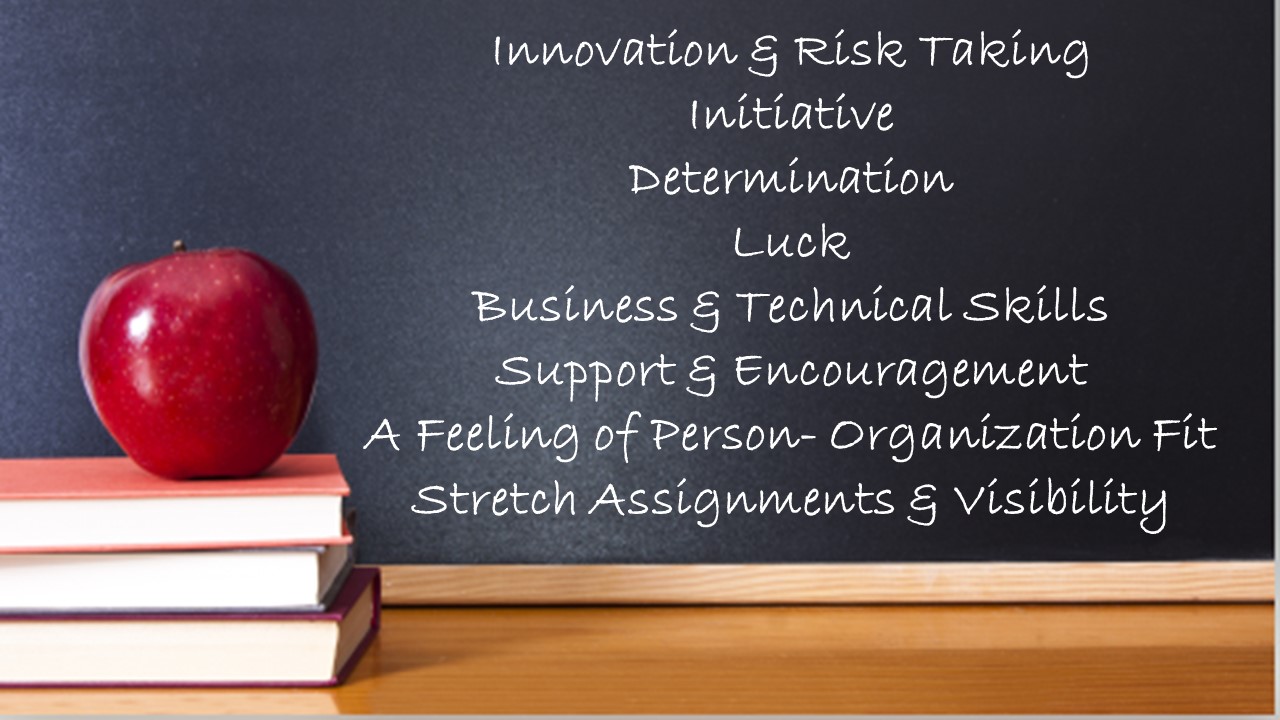
The research considered early career, mid career, and mature career phases.  A key observation from early career reflection was that careers start in school.   Executives considered their early years and education as part of their career story.  At mid career, the most common enablers to career advancement identified in this research were:

Lessons

There were fewer barriers described by participants which suggests an overall forward progression for their careers.  They typically had worked in 5.3 organizations and had 9.3 positions over their careers.  Half had lived and worked in more than one region of Canada. Of the barriers, more were described by women than men.

Career highlites for these executives came from advancing the careers of others and from paying it forward through mentorship.  Mature career reflection featured this theme of sharing career luck with others who are at an earlier career stage. There were a few laments about promotions missed, and money lost but mostly it was full circle, back to commencement, right around when it all began.

So, graduates, soon-to-be graduates, and students consider these two questions:  When did your career start?  What are your emerging career advancement enablers?  Maybe you’re experiencing post-commencement career advancement.