
Making Sense of Trump v Carney – a Fantasy Thought Experiment

Like many people today, I’m trying to make sense of what’s going on between Trump and Carney. I found inspiration in a short, funky video where two economic thinkers – John Maynard Keynes and Friedrich Hayek – are portrayed as party guests and their competing philosophies are explained in a rap-style battle. One says, ‘People are leaving – turn the music up and keep the party going.’ The other replies, ‘The party itself caused the mess – shut the bar and deal with your hangover.’ That theoretical argument never ended. It just reappeared in modern politics.

Donald Trump talks like the host who refuses to let the party die. If markets wobble, he wants lower rates. If growth slows, he pushes stimulus. If institutions resist, he wants different people in charge. It’s confidence-first and momentum-driven – very Keynesian in spirit.

Mark Carney sounds different. At Davos, he didn’t threaten markets or moralize. He calmly described what happens when rules weaken and trust erodes. Markets didn’t panic – they recalculated. That’s the Hayekian warning in spirit – not ideology, but restraint.

The contrast is simple: Trump promises to keep the party going, while Carney worries about whether the living room floor can take it. But it doesn’t have to be a choice.

Imagine a world where they don’t try to convert each other. Instead, they work together. Trump would create momentum – confidence, investment, urgency, visible growth. Carney would supply the guardrails – calmness, credibility, institutional independence, and boring but trusted rules. Trump supplies energy, Carney supplies stability.

That balance is what I want, and I believe most everyday people want it too: progress they don’t have to constantly worry about. Now for the fantasy – not as a proposal, but as a way of thinking. Let’s call it a thought experiment: clearly unrealistic but revealing.

What if Carney ran the U.S. Federal Reserve? Not literally. Not politically. This isn’t a prediction or a proposal. It’s a way of asking: what kind of system behaviour do people like Carney represent – and why does it feel stabilizing when someone like Trump is around?

In this imagined world, Trump is still Trump. He pushes growth, speed, and visibility. He talks confidently. He absorbs political risk. He doesn’t suddenly become cautious or technocratic. But the Federal Reserve is run by someone with Carney’s instincts. What changes is not ideology — it’s boundaries.

In this fantasy, Trump still says, ‘I want growth.’  The Fed still says, ‘Interest rates are set by data.’ And markets believe both statements at the same time. Carney doesn’t promise lower rates. He doesn’t time decisions to politics. When the data is marginal – could go up, could go down – he defaults to protecting trust, not pleasing anyone.

That behaviour has real effects: markets stop guessing about political interference; long-term interest rates stabilize; fewer sudden mortgage shocks hit households; inflation risk is addressed before it shows up in grocery bills. Nothing dramatic happens. And that’s the point.

Sadly, this is a fantasy – and highly unlikely to go much further than my attempt to make sense of the world today. For the record, I’m still confused and concerned.

Video Credit: Fear the Boom and Bust: Keynes vs. Hayek (2010), created by John Papola and economist Russ Roberts.

PS Real economists would probably argue that it’s not appropriate to describe Trump as purely Keynesian or Carney as purely Hayekian. Neither is pure – but my interpretation of the contrast seems fair, at least for this fantasy experiment.

PPS This article reflects my personal views and is not intended as a political statement, nor does it represent the views of my employer, clients, or any affiliated organizations
How to Miss The Point – Completely

I wrote a piece earlier this year about how Canada and the U.S. could actually improve their relationship and come out ahead – both sides. A good old win–win. But if the last year has shown us anything, it’s that Trump’s idea of trade is more like win–lose. And most Canadians I know (myself included) are not impressed.

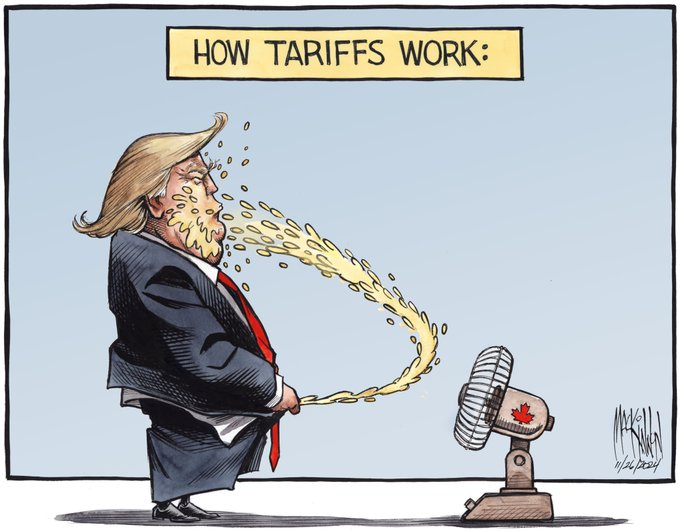
Instead of working things out or trying to understand how tightly our economies are linked, he went full steam ahead with tariffs and tough-guy talk. Steel? Tax it. Aluminum? Tax it. Finished goods? Throw a duty on those too. It’s like someone walked into a dinner party, flipped the table, and called it strategy.

Canadians are polite, but we’re not pushovers. And this kind of move – bullying trade partners with zero finesse – just made people angry. It made me angry. Tariffs don’t magically bring jobs back or fix supply chains. They mostly just make things more expensive and strain relationships. And if Trump thinks that’s a win, I think he’s missing the big picture.

Bruce MacKinnon’s brilliant cartoon in the Chronicle Herald really sums it up:

Image Credit: Bruce Mackinnon https://x.com/CH_Cartoon/status/1886189236644188279

It’s like we’ve taken decades of steady trade, teamwork, and peace-of-mind between Canada and the U.S. and tossed it out the window for cheap political points. Newsflash: Canadians notice. And we don’t love being used as a punching bag for someone else’s ego.

There are real people on both sides of the border who just want to live, work, build, and trade. We don’t need drama. We need leaders who understand the difference between strong leadership and needless conflict.

Here’s hoping for better days – and better neighbors who see the big picture.

This article reflects my personal views and is not intended as a political statement, nor does it represent the views of my employer, clients, or any affiliated organizations

The point is to be better. Period.

There’s a grand geo-political redesign in the works or so it seems. The world has lots of moving parts and they’re moving faster and faster these days. Will the wheels fall off? Maybe. I’d like to think not. I’m open to any possibility. Are you?

I read with great interest Andrew Coyne’s opinion piece “The point is not to be different from the States. It’s to be better than them.” I respect the award winning journalist and I appreciate my subscription to his work, but today I struggle with what seems to be his fundamental assertion. Coyne’s piece insightfully analyzes the Canadian identity (crisis). He offers context about Alberta and Quebec (my home province) and their separatist tendencies. He describes Canadian culture and highlites some of the many features of our country including Medicare. Its a great article which I encourage every Canadian to read.

Its Coyne’s assertion that one country needs to be better than the other that I fundamentally question. Many people today are observing challenges to the status quo and digging in their heels to defend their current reality. They seem to be taking hard positions that bold new ideas are just plain wrong. Coyne does a great job of describing a range of possibilities for Canada’s future but seems closed to the idea that a new thing might be better.

There might be a new deal between Canada and the United States that, in the long run, could make the world, and my grandson’s life, better. I want to be open to that. We don’t need to be better than them. And they don’t need to be better than us. We just need to be better (off). All of us.

I’m tired of choking on my breakfast as I read newspapers and yelling at late night TV seeing politicians (and the journalists who help to keep them accountable) dig in their heels. I have a degree of hope that there is a better tomorrow out there and that it could be different from what we know today. We need to be open to that, and we need to listen to the possibilities without dismissing the people who offer them. I have reservations about Donald Trump as do most Canadians that I know. I also have reservations about our current and candidate Canadian political leaders. I’m trying to give them all the benefit of the doubt. And its not easy. I’m hoping that they can lead us all to a better tomorrow, including maybe one that is very different from today.

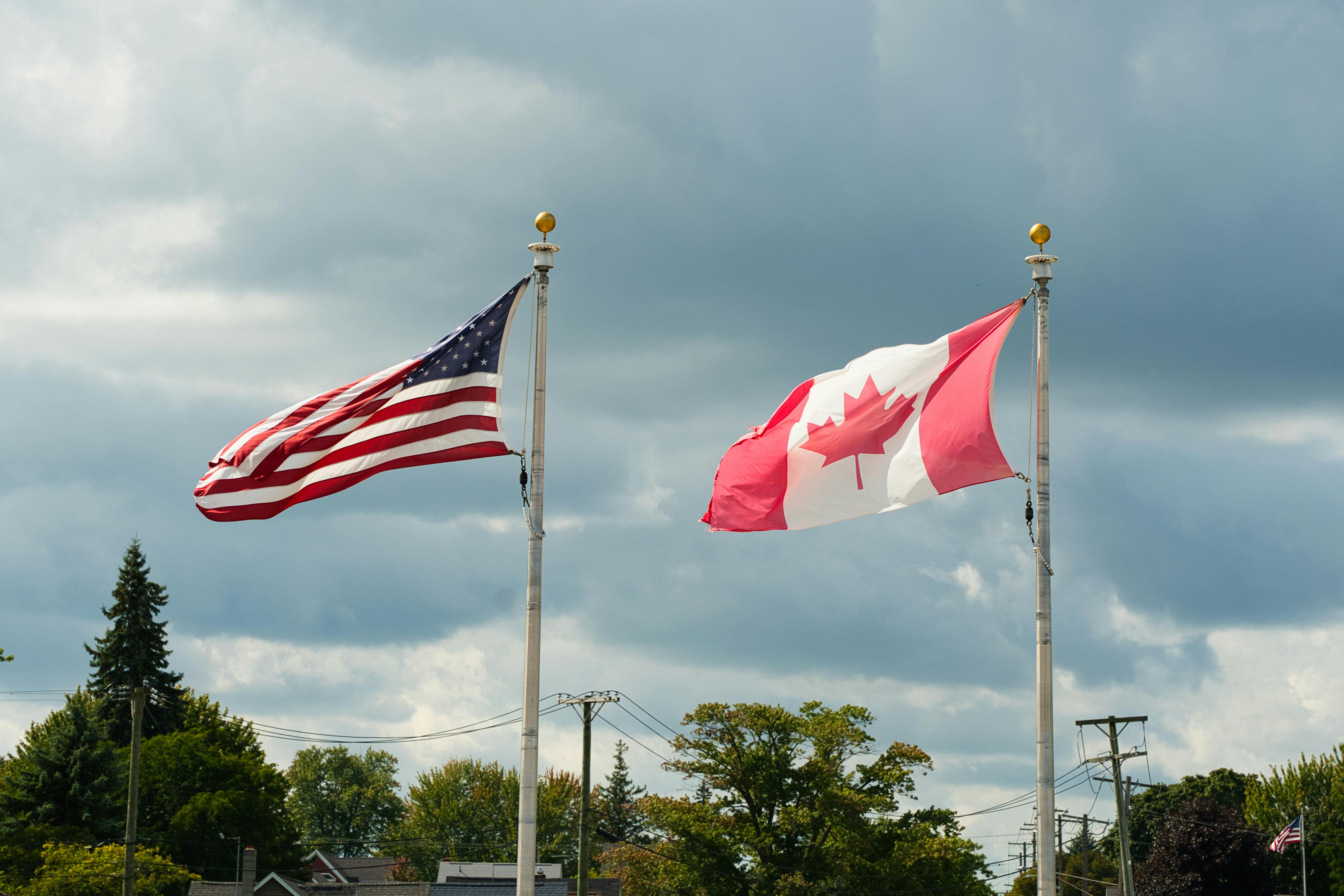
Photo Credit: Thomas K, pexels

This article reflects my personal views and is not intended as a political statement, nor does it represent the views of my employer, clients, or any affiliated organizations