Addressing complexity with open design thinking

Sometimes its tough to see the big picture, especially when its really ugly. Our world and everyone in it are facing some ugly problems right now. They are problems that are wickedly unstructured, open ended, multi dimensional, systemic and for which there are often no solutions. Our wicked problems require a new way of thinking and a new leadership paradigm. This week the global climate strikes offered evidence of a wicked problem. Where do you begin? There are so many unique yet interconnected elements each of which seems radically unpredictable. Without directly referencing the science, suffice it to say that the debate, let alone the hope of a solution, seems beyond our control. Don’t despair. Fortunately, this week also offered some hope for our future and not just in the form of #teamgreta and the many brave climate change activists.

systemsinnovation.io

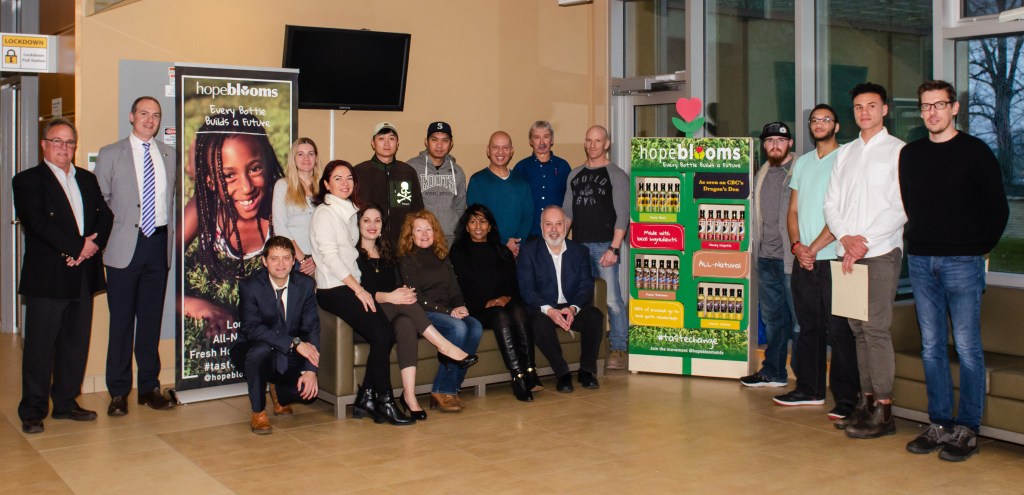
This week three global industry leaders shone a light on a new way of thinking which is credited as the kind of new management approach which our world needs now. Deloitte, IBM, and RBC joined forces to offer Nova Scotia post secondary students a taste of design thinking. The investment which these companies made in developing and delivering the two-day learning event was impressive. The scale of the event was significant, involving about 200 students from five schools all hosted at Saint Mary’s University. Yes the three corporate amigos got to see potential recruits in action and endeared themselves to a cohort of future leaders – the event helped their recruiting efforts for sure but I think the investment goes far beyond that.

Opening up the internal capabilities of these firms for others to learn and apply took a leap of faith for these three industry giants. They offered their know-how and their people in an effort to build community capacity so that we can begin to solve a growing world of wicked problems. The open source nature of the design thinking movement is evidence of healthy corporate values which help to address community and social issues – not just profit. In a world of wicked problems its nice to see some creative solutions emerge. Bravo IBM, Deloitte, RBC and all the student participants who made an investment which will make a difference and some day may get us to the other side of complexity. Post-complexity simplicity here we come!

Do Canadians believe in education?

Most Canadians believe post-secondary education positively impacts the country, is more relevant in today’s rapidly changing world, and makes us stronger in the face of new challenges. A new national survey conducted by Abacus Data for the Canadian Association of University Teachers offers some interesting insights including that 78% of Canadians believe public sector education (PSE) positively impacts the direction of the country

Most Canadians believe PSE is more relevant now than ever. A full two thirds agree that it has never been more important to get a post-secondary education now given the changes in the economy and society.

When told that Canada has the highest rate of residents with a post-secondary degree among comparable countries, two thirds of respondents feel it makes Canada a better place to live, a view that’s held across demographic, regional, and socio-economic groups. Given the importance of PSE in the eyes of Canadians it is likely that it will play a prominent role in the upcoming federal election. Although a provincial jurisdiction, federal policies supporting the sector are likely to be a focus. For more information visit Canadian Association of University Teachers, http://www.caut.ca July 23 post. Photo credit widehdimages.

How should graduate success be measured?

Graduates from Nova Scotia earn about $60K per annum five years after completing their first degree (about 96% of them anyway) according to research conducted by the Maritime Provinces Higher Education Commission in 2018. This is a useful measure, but it begs the question what are the most appropriate ways to measure graduate success? Surely some more subjective factors are considered relevant.

It is generally accepted that careers have an internal and an external dimension. The external dimension relates to the career as perceived by others where the internal dimension relates to notions of self. In addition to compensation, other common objective/ external measures include the number and rate of promotions, span of control, hierarchical level or rank, and perceived importance of job outcomes. Subjective/ internal career success outcomes commonly include career satisfaction, happiness, emotional well being, physical health, and work engagement.

The external career dimension gets the most attention although increasingly research is focusing on the internal dimension. Post-industrial society has experienced changing notions of career success that have coincided with, and may be influenced by a transition in values to a post-materialist view.

An increased focus on self-expression values, subjective well-being, self-expression, and individual spirituality has emerged (Dries, 2011). These values differ across cultures but the transition to a post materialist view has been most evident in affluent societies, such as North American. This transition has challenged ideology, such as “the American dream” and its influence on notions of success.

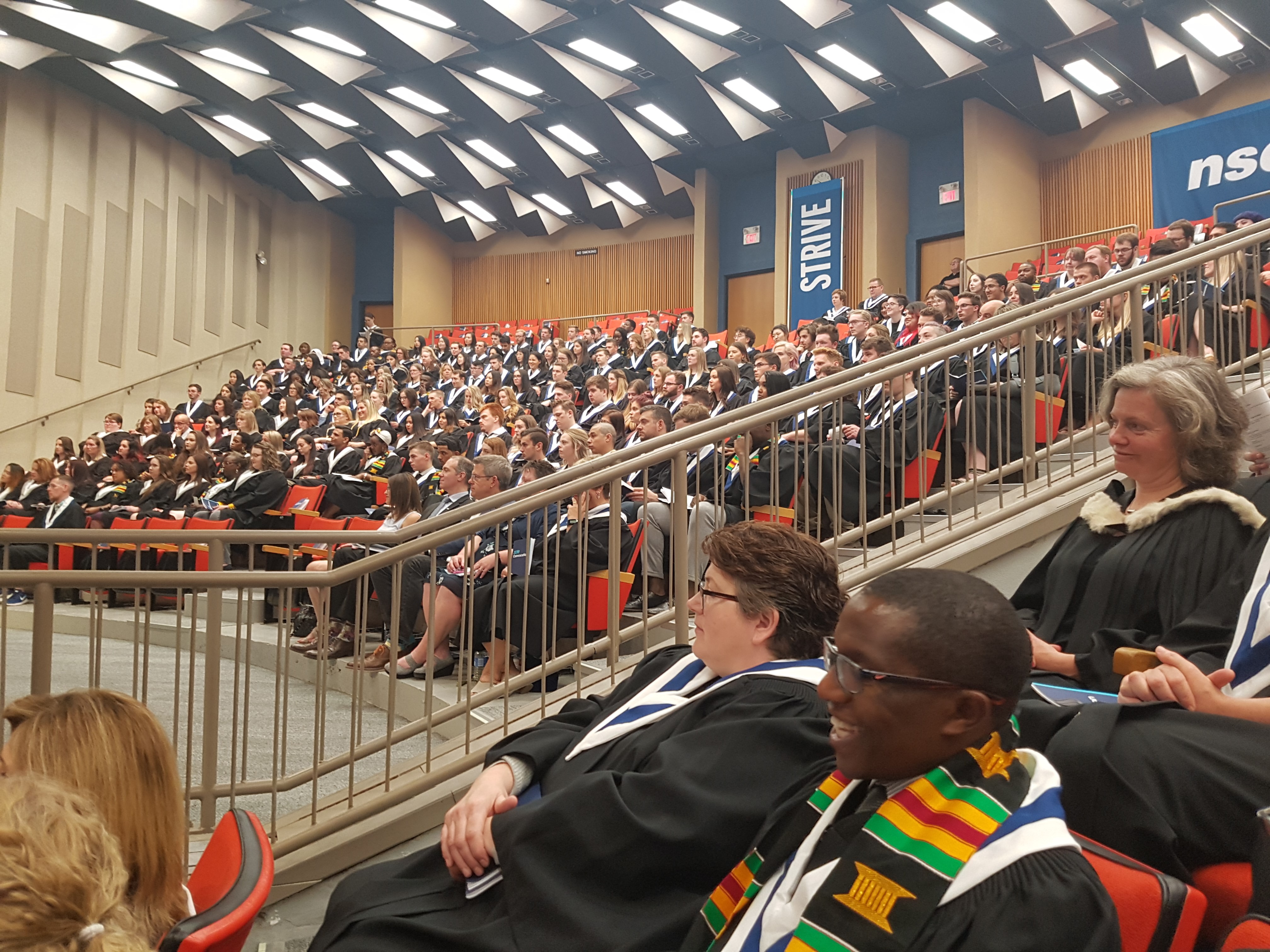
Nova Scotia Community College Convocation 2019

Post-commencement career advancement

There’s a lot of graduating going on these days and more to come.  Bravo to all the teachers and learners who are making it happen.  It’s time for celebration and reflection.  A common commencement address theme is that of the career.  My research suggests that some students don’t think seriously about their careers until long after graduation. My teaching experience is further evidence of this – despite best efforts.  It was also my workplace experience that many people don’t look ahead at their careers. Most people spend more time thinking about jobs.

Recently I asked 48 Canadian senior executives about their careers to identify barriers and enablers to career advancement.  The interviews were quite personal and very reflective.  In many cases these executives from across Canada shared their life stories with me.  Most of these people had achieved career success seemingly by all standards. Following a reasonably rigorous methodology, I identified the most common barriers and enablers to their career advancement.

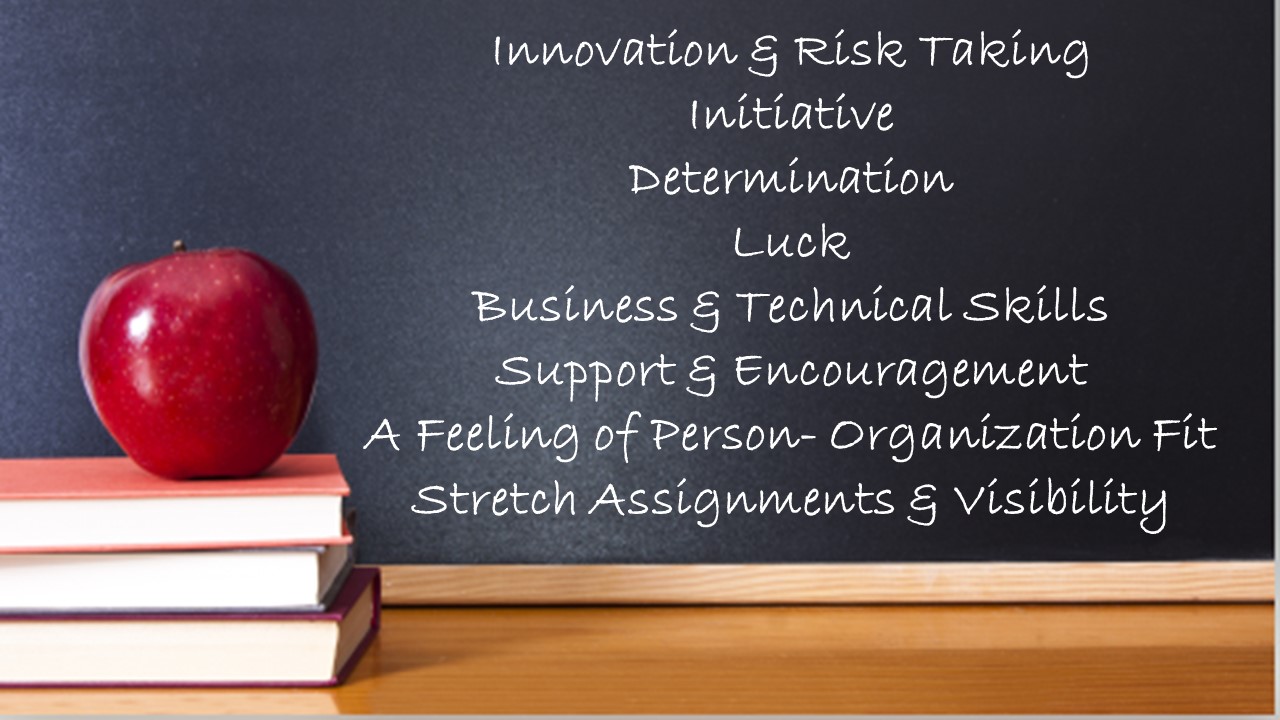
The research considered early career, mid career, and mature career phases.  A key observation from early career reflection was that careers start in school.   Executives considered their early years and education as part of their career story.  At mid career, the most common enablers to career advancement identified in this research were:

Lessons

There were fewer barriers described by participants which suggests an overall forward progression for their careers.  They typically had worked in 5.3 organizations and had 9.3 positions over their careers.  Half had lived and worked in more than one region of Canada. Of the barriers, more were described by women than men.

Career highlites for these executives came from advancing the careers of others and from paying it forward through mentorship.  Mature career reflection featured this theme of sharing career luck with others who are at an earlier career stage. There were a few laments about promotions missed, and money lost but mostly it was full circle, back to commencement, right around when it all began.

So, graduates, soon-to-be graduates, and students consider these two questions:  When did your career start?  What are your emerging career advancement enablers?  Maybe you’re experiencing post-commencement career advancement.

Reflect yes, but don’t beat yourself up

Dwelling on missed opportunities or mistakes is human nature.  A colleague recently lamented that she had left a great job to find a better one, only to realize that the grass was much greener in her original position.  She repeatedly regretted her decision and in some ways was paralyzed by it.  Researchers have found that obsessing over regrets has a negative impact on mood and sleep, can increase impulsivity, and can be a risk factor for binge eating and misusing alcohol (Taitz, 2019).

Abstract lights

Participant memories about negative career experiences were quite clear – even those long ago.  Reflection should be positive.

When asked about career regrets in a study of Canadian technology executives the most common answer was denial of negative reflection, “Oh I don’t dwell on  the past” (Fauteux, 2017).  When pressed during interviews, participants described a range of regrets including assignments not pursued, transfers not accepted, promotions not lobbied for, and other moments in time that could have been (better).  Their memories were quite clear about decisions made long ago.  No doubt you have some career regrets, I do! Its important not to let them get a hold of you.

Psychologists suggest that in order to avoid regret spiral you need to interrupt your negative thought pattern and look to the positive.  Taitz, 2019 describes this as interrupting your obsessing and treating yourself like your ideal mentor would.  Don’t beat yourself up – practice self compassion.  Her science explains once again what we know intuitively but sometimes can’t put into practice – see the sliver lining.  Life long learners who use reflection may know this best – there is positive value in every experience.

Kintsugi is a Japanese art which literally translated means “golden repair.” It is a philosophy of repairing broken things, including imperfections which are considered part of an item’s history.  So, life long learners, take time to reflect, look for the positive in every experience, and repair the broken thing(s) which are part of your career.


A Shout Out to Women at Work

There’s no denying that women face more barriers in the workplace than do men.  On International Women’s Day it’s appropriate to pause and think about what that means and what we should do about it.  On balance women are paid less than men for the same work.  They need to do more at work to advance their careers.  They put up with more crap than men – mostly crap that comes from men. Through it all they persevere.

As a society we are slowly marching towards a day when the playing field for men and women will be level.  Sadly, that day, when we reach parity, won’t happen in my lifetime. But it may happen during the lifetime of my grandson, who I hope will grow up to advocate for women – to be a feminist.  I maintain this hDream Job Green Road Sign With Dramatic Clouds and Sky.ope, and I take this position, in part because I had the privilege of listening to the life stories of men and women from across Canada as part of a research project which I undertook a couple of years ago.  I learned that all of us face barriers and enablers to career advancement – mostly barriers.  I also learned, by listening, that women face many more barriers than do men.  We don’t seem to make it any easier for them, but we should. We should give them a push and we should feel no shame in that. We should be proud to do it.  Taking proactive steps to right a social wrong is only a good thing.  Moreover, it’s a smart thing.  All evidence points to the fact that diversity in organizations, including as it relates to gender, leads to better decision making and better overall business results.
As part of my research I met with senior leadership teams from several Canadian organizations and, in group meetings, discussed the under representation of women in senior positions.  I also offered a range of solutions which might help them to change the mix – to increase the representation of women in their organizations.  Most of the leadership teams I met with, like in many organizations around the world, were predominantly male.  Most of them politely acknowledged that the gender gap existed but did not take up the invitation to adopt any of the solutions offered.  Some of them did, but they were by far the exception.  My interpretation of the overall conclusion from these executive team meetings was a message, something like, “that’s interesting, we’re in good shape, thanks for coming out.”  Really?

International Women’s Day is a good time be reminded of the realities of our workplaces and the careers of women.  They face barriers.  We all need to understand that and do something about it.  We should seriously consider measuring gender diversity and setting targets for more balance.  We should figure out how to deliberately change the mix and increase the representation of women, especially in senior positions.  Hopefully this shout out to women at work will contribute to that shift, that positive change, and nudge us in the direction of parity.


An Industry Life Gone Too Soon

I was reminded this week of what it takes to build an industry.  It was an unfortunate collision of academic theory and a real-life story of someone special leaving us too soon.   Industries go through life cycles, from introduction to decline, and a major force of industry growth is the production and diffusion of related knowledge (Grant et al, 2015). Growth Curve

Many textbooks feature images which illustrate industry or product evolution over time, sometimes called growth curves.  The similarity of these growth curves to the cycle of human life was made abundantly clear this week with the passing of an information technology icon.  Rod Wark was a Nova Scotia leader with a global reputation for his significant contribution to the sector’s growth.  He was an early adopter, an innovator, and obsessed with quality.  He led many individuals and organizations through the IT sector’s introduction, growth, and maturity.

Rod Wark significantly influenced the lives of more than 13,500 workers (ICTC, 2015) in Nova Scotia’s IT sector.  But the IT sector is special because of the multiplier effect it has on the economy by enabling the success of other sectors.  Rod Wark made a significant contribution to the growth of the IT sector, its people and companies, but he was also a profound influence on the growth of a much larger business community.  He was a builder, who’s impact should be celebrated and used as a lesson for many, long into the future.

What I have learned…

For many,20161001_085739 this week is a homecoming, a return to alma mater, and a time for (enhanced) reflection. I was privileged to have a great educational experience. I am privileged. Period. And I never take that for granted. I have leaned a lot but as I come home and I reflect, here’s what I conclude that I have leaned. Three things…
All people are decent! Despite the hate in this world and all the nasty things that people do to each other, deep inside, at the core, people are decent. To see people any other way serves no purpose. Assume that we are all essentially good even though our actions sometimes suggest otherwise. In the long run, our behaviours at least approach decency, and given enough time we will all get there.

The truth must be told! Although ‘truth’ in the sense of knowledge and science is sometimes hard to know, at least the moral truth is always evident. You can’t hide from it. You need to seek it. There is no point in lying. You may get away with it for a while but it will gradually eat you up inside. You might justify not telling the truth to protect other people. But they can take it. And they’ll forgive you. After all, they’re decent.

Fear is what holds us back! Take a look at anyone with a disability or anyone who has ‘overcome the odds’ and you’ll see someone who has embraced fear. People who are considered as gifted or ‘natural,’ at one time overcame a fear of not meeting rising expectations. If you’re honest with yourself about what you want, big or small, and if you’re not achieving it, you’re probably just afraid. Reaching goals requires that you overcome fear. Get out of your comfort zone and just do what you truly want. If you fail, and you admit it, people will support you. After all they’re decent.

My alma mater has always been a place of learning for me. As I walk around campus, 35 years after being graduated, and ask myself what I have learned, the answer is not in the text books. At least not the business ones. Supply and demand, fiscal policy, sensitivity analysis, cost allocation, debits and credits, strategic frameworks, bla bla bla are all important but they’re not the stuff of life.

Thirty five years on, what I have learned is: All people are decent; the truth must be told; and fear is what holds us back! Now, where was I? Oh yes, I need another drink. Cheers!

Respect Stares Down Ignorance

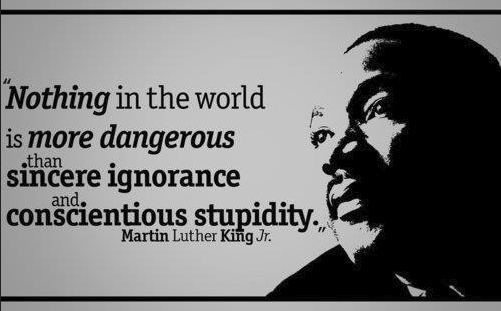
It seems a car load of people failed social studies and failed society in general when they mouthed off to a man in Edmonton this week.  It’s sad to think that racial slurs continue in Canada (or anywhere for that matter).  We’ve all got some learning to do about how we treat each other and back-to-school season is as good a time as any to refocus on social justice, inclusion, and respect.  It’s time to look ignorance in the eye and stare it down for good.Ignorance

The ignorance demonstrated by the carload of people who slurred Jesse Lipscombe is shocking.  It sends a message about how far we have to go and how much more people like Jesse need to endure until we all treat each other with respect.  I am grateful for having been raised in an environment which promoted respect.  I feel sad for the carload of ignorance in Edmonton which seems to have missed out on that.  We need to help them to be better.  We bear some responsibility for their ignorance and their actions.

It’s one thing to “call it out when you see it,” but it’s another, far more impactful thing to do something about it.  I’m not sure how to do that.  Hopefully, if that moment comes I’ll lean in the way it seems Jesse did.  I’ll look ignorance in the eye and calmly say, “Really?”  I’ll stare it down, with respect.


“Just Kick the Shit Out of Option B”

SandbergI am fortunate to be researching the careers of executive women and men who have been leaders in the Information Communications Technology (ICT) sector.  I have heard many great stories from these leaders and I hope one day to share them so that others might learn and grow.

Many of the stories I am hearing describe how people have overcome setbacks in their careers.  These stories often connect with sad chapters in their lives more broadly.  Its encouraging that these stories feature more good experiences than bad ones.  They are more about what moves people forward than about what holds them back.  However, the stories of adversity somehow seem to lead to greater learning.

I am a big fan of Sheryl Sandberg and how she has become a spokesperson for gender equality.  She is a great leader in the ICT sector.  She is a role model for men and women, young and old.  Her May 15, 2016 commencement address at UC Berkeley was very powerful and gets a big Facebook “Like” from me.  I encourage you to take 20 minutes to listen to her.  Commencement is continuous and thanks to technology it is ubiquitous too.  Check out her speech.  I’m betting you’ll find value in her message, and you’ll learn.

In Sandberg’s words, “A commencement address is meant to be a dance between youth and wisdom.” She does this dance beautifully, with a unique and personal twist.  She describes the recent death of her husband and how her family has dealt with the loss.  Some salient passages of her speech include, “When option A is not available just kick the shit out of option B.’ and as a conclusion, “How would you live today if you knew you had 11 days left?”  Thank you Sheryl for continuing to explore what it means to Lean In to life.