Patagonia Doubles Down on Planet

I was pretty excited last week with the news of Patagonia’s Yvon Chouinard essentially giving away the company to a tightly managed trust committed to his dream of saving the planet. While I haven’t researched the news other than casually it seems super impressive that he took such a bold step now.

Chouinard is not the first business leader to take such a non-monetary long-term unorthodox view. Apparently ‘giving away the farm’ to save the planet is all the rage in Europe and the Nordic countries. My students quickly pointed out the tax savings it would bring to Chouinard and his family. But overall they paused to think how they could one day offer a similar gift.

If you’re like me you might marvel at how someone can be so focused. Chouinard has been saving the planet his entire life. Wow. One single focus. That’s impressive. Its inspiring to have leaders like him to study and hopefully to model. What the world needs now is more than just people marveling at the bold moves of others. We need to make some bold moves our selves.

Lots of things are different now. If you wanted to participate wardrobe is as good a place to start as any. After all you are what you <insert wear>. Your wardrobe might become smaller as you give it away to those more needy. More of your wardrobe in future might be like Patagonia’s – more function than fashion. But wardrobe is not the point! One could change life style – being more outdoors and grounded. A big change for some could be much more biking and a lot less motoring. Ultimately Chouinard has challenged us all to think about this rock and how we either save it or kill it. I chose to save it – or at least try. I’m going to figure out how I can best do that now. Thanks for the push Yvon!

Jane and Jack the Ripplers

When presented with new challenges or opportunities people often say something like, “I’ll get to that when things settle down.”  No, they won’t.  That response generally means they’re more focused on the now and not embracing the future.  They’re like still water.  Successful organizations, teams, and individuals are in a constant state of change.  They’re like rippling water.

There are lots of good reasons why organizations, teams, and individuals don’t change.   Fear of the unknown is a common reason cited.  People are often in a comfort zone where their desire to change is outweighed be whatever is holding them back.  They’re stuck.  They need a rippler.  

Say, for example, there’s a new system being implemented at a workplace.  The old system has been in place for many years, and a common lament from team members is, “it works just fine.”  For them to leave their comfort zone and embrace the new unknown system something special needs to happen.  Most importantly they need to see movement towards the new system by their leaders and their teammates.  They need to see the ripples of change.  That’s not an easy thing to create but it can be done.  Its called change management.

There are many change management theories and methodologies.  They are generally grounded in social science and are often both academically pure and commercially successful.  Many PhD’s have been earned answering questions about change management and many consulting fees have been paid for helping to manage the people side of change. One common theme seems to be that someone needs to start the change wave which is sometimes referred to as change sponsorship.  The higher up the organizational hierarchy, the better the impact of change sponsorship, but it needs to start somewhere.  Someone needs to drop a pebble in the still water and make the water move for others to notice. That’s when their desire to participate in the change increases, and generally that’s when they begin to “get it and get with it.”  There needs to be a rippler. 

So, ask yourself, when it comes to change are you a rippler?  If you think you might be, then consider learning more about change and change management.  There are many great resources available to help you become a change manager.  Dr. John Kotter developed a highly regarded change process as did Jeffrey Hiatt and Tim Creasy who founded a research and training organization dedicated to change management.  Check out their stuff.  Maybe you’ll become a (better) rippler!

The gender wage gap ticking time bomb

It isn’t a dirty little secret anymore. Most people realize that there is a gender wage gap. Women earn less than men for doing the same work. Yet another report, based out of the University of Ottawa this week, shed light on this reality. For college graduates, at time of entering the workforce, the gap is 25%. Like climate change many organizations don’t seem to pay much attention to the nagging problem. If they did, it wouldn’t still be a problem.

Apart from being illegal, immoral, and irresponsible, ignoring the wage gap problem is just plain stupid. But then again so are a lot of things we do subconsciously or without thinking about the consequences. Consider this. You’re an executive in a mid-size organization and things are chugging along nicely. Sales are at their highest levels, you have a good pipeline, costs seem reasonably in line, profits are strong again, and you’re drawing a healthy bonus. Tickity boo. Then – boom – 30% of your workforce begins to unravel. They’re pissed! They begin to realize that you’ve been paying Harry a lot more than Sally. Then they realize that you’ve been paying most of the Harry’s a lot more than most of the Sallys. Their data about your payroll is anecdotal, just water cooler chatter, but to them its very real. Their ‘give a s**t factor’ declines rapidly, they slow down their work efforts, they leave for greener pastures, and you’re left with a big mess. Your mess.

Wake up Scrooge! If the data from the University of Ottawa based study and the hundreds of other studies showing that we pay women less than men for the same work is real for social scientists, then surely its real for at least some of you. At least some executives are guilty of something here. Yes, you too probably don’t even realize that you have a problem. Here’s an idea. Do the math, look under the numbers, resist rationalizing the individual cases. Stop coming to the conclusion that, “we’re OK but thanks for the data.” It may not bee too late to avoid one of the hashtags potentially coming your way. Moreover, it may not be too late to just do the right thing, and the smart thing. According to good research, women (in our example here 30% of your workforce) are the ones making things tickity boo for your business today. Don’t take your success, or their contribution for granted. Don’t be on the wrong side of history. Act now, time may be up sooner than you think.

A shout out to social entrepreneurs

Social entrepreneurship is hot right now, especially among young people. Its evident in the class room when students talk about business and its evident from the growing numbers of social ventures in our communities. Social entrepreneurship is where monetary profit becomes a tool to accomplish people-centred objectives. More than economic activity, social entrepreneurs give society inspiring world-changing solutions. And we need them now more than ever. Social entrepreneurship matters because it maximizes social benefit for many rather than maximizing profit for a few.

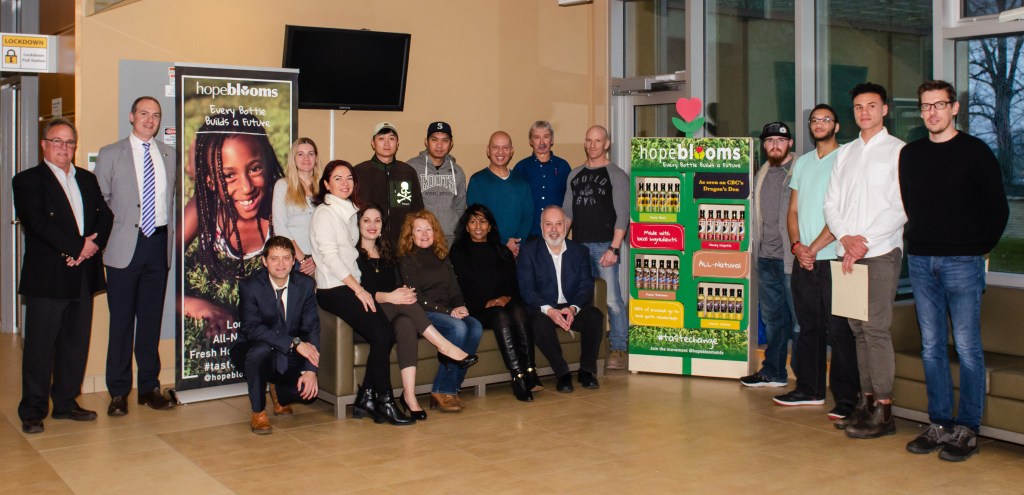
A brilliant example of social entrepreneurship can be found in Hope Blooms who burst onto the national stage in 2008 winning the hearts of Canadians including most of the CBC Dragons. Only Kevin O’Leary was a hold out to their ask, sticking to his oft used excuse that he doesn’t invest in charity. He didn’t get it. Scrooge didn’t either until it was almost too late. The other Dragons were taken by the story, which is now regarded as one of the top ten Dragon’s Den pitches of all time. The Hope Blooms youth who made that first step were not unlike the ones who recently opened up the Toronto market so that Hope Blooms products can now be found at the Loblaws store in Maple Leaf Gardens. They are Halifax inner city kids. They are bold entrepreneurs.

Hope Blooms builds community and change. While they grow, transform, package, and sell food in the form of dressings and teas, what they really produce is people. Hope Blooms alumni are now attending post secondary institutions including Stanford University, University of Toronto, St. Francis Xavier University and others. When shoppers chose Hope Blooms dressings at their local Loblaws store they are investing in future leaders who will soon make our world a better, more inclusive, and loving place. They are investing in social entrepreneurs. Jessie Jollymore, Hope Blooms founder, is a classic social entrepreneur. Her dogged commitment to planting seeds and harvesting dreams is an inspiration to us all. Thank you Jessie and all the social entrepreneurs who are leading change in our economy and our world. Keep up the great work.

An Industry Life Gone Too Soon

I was reminded this week of what it takes to build an industry.  It was an unfortunate collision of academic theory and a real-life story of someone special leaving us too soon.   Industries go through life cycles, from introduction to decline, and a major force of industry growth is the production and diffusion of related knowledge (Grant et al, 2015). Growth Curve

Many textbooks feature images which illustrate industry or product evolution over time, sometimes called growth curves.  The similarity of these growth curves to the cycle of human life was made abundantly clear this week with the passing of an information technology icon.  Rod Wark was a Nova Scotia leader with a global reputation for his significant contribution to the sector’s growth.  He was an early adopter, an innovator, and obsessed with quality.  He led many individuals and organizations through the IT sector’s introduction, growth, and maturity.

Rod Wark significantly influenced the lives of more than 13,500 workers (ICTC, 2015) in Nova Scotia’s IT sector.  But the IT sector is special because of the multiplier effect it has on the economy by enabling the success of other sectors.  Rod Wark made a significant contribution to the growth of the IT sector, its people and companies, but he was also a profound influence on the growth of a much larger business community.  He was a builder, who’s impact should be celebrated and used as a lesson for many, long into the future.

Death and Taxes

Today is my birthday.  Its also a day when I’ll be attending a wake for a family member. Today the Chronicle Herald headlines are about the upcoming provincial budget and the state of our province.  Last night I attended a workshop for my professional association where we discussed how Certified Management Consultants could take action to support the One Nova Scotia Coalition in response to the Ivany Report about the future of our province and its Now or Never call to action.  One of my newest best friends hosted the workshop.  She was the only women among 12 men exploring how we could do something to make a difference in the future of our province.  This morning I woke up thinking how privileged I am.

In many respects our province is dying.  No doubt it will continue to be a a great place to live for a long time.  There are many success stories and many missed opportunities which we share.  So here’s a quick birthday thought for fellow Nova Scotians.  Two questions. What have you done in the past year to support an immigrant to our province?  How have you helped innovation and entrepreneurship in Nova Scotia?

If we are to have many more birthdays and avoid premature death, we should each think about these questions more often.  Now would be a good time.  Then, now, we should wake up and do something about it.  And the answer is not in paying more taxes. Failing to think, plan, and do in response to these questions is not an option.  Happy birthday!Ivany

Students success just makes you feel good all over…

Tonight I had the pleasure of watching a success story.  Some students I had the good fortune to work with for a short time walked into the Dragon’s Den on CBC television and walked out with a $500,000 investment in their business.  I knew they were good, really good, but this was validation of the highest order.

About 18 months ago a colleague of mine, Ed Leach, who was teaching a new course, Starting Lean, was kind enough to introduce me to these students and give me an opportunity to work with them.  I learned a ton from the experience.  Most of all I learned that determination pays off.   I watched Cam and Dan push an idea forward.  As their “mentor” I was more of a cheer leader.   They made some predictable mistakes but that didn’t matter.  They pressed on. These were real real entrepreneurs.

I watched 2 very smart, very talented, very determined young men follow their instincts and make things happen.  I connected with them a few times following the conclusion of the course, as the business really got going.  Although their career success was a sure thing, truth told, I thought the chance of success with this venture was 50/50.  Alas I am not an entrepreneur at heart.  I was delighted to see Cam and Dan (and their partner Bobby) successfully pitch and win a big investment on prime time TV.  It was better than seeing the Habs win a big game.   As someone who wants to teach more and more, watching these recent students compete and win for real just made me feel good all over.  Thanks again Cam and Dan!  Even if the deal doesn’t stick, as sometimes happens, you are real entrepreneurs we can all be proud of.

Sage