Sometimes – Just a little push…

A senior executive once described her career as “remarkably tougher than that of my male counterparts. All of them.” Science says she’s in the majority, at least when it comes to male dominated sectors of which there are far too many. Research says senior executive women in the technology sector feel career drag because of their gender (Fauteux, 2017). Progress has been made but the gap persists. Like many I look forward to the day when the reality of equity and diversity is here. Alas it’s not here yet. You don’t need to look far to find local examples of what is all too visible around the world. Its tough for women and girls.

We know that there is a gender gap in the tech sector, especially in the senior ranks, yet we seem powerless do do much about it. One reason we sometimes avoid the ‘dirty little secret’ relates to our fear of overcompensating. ‘If our affirmative action goes too far then we’d just tip the scales the other way and that’s not equity, yada yada.’ So we do less or little.

Today on International Women’s day lets try to “give a little push” to what seems to have been screwed up otherwise. Lets find small (and big) ways to tip the scales more towards equity for women and girls, and in general. Let’s say something or do something that might feel uncomfortable to us in the interest of advancing women. These suggestions are especially for men, today, but they apply to everyone always (at least a bit).

Try using pronouns in your stories of ‘she/ her’ instead of ‘he/him.’ When you tell a story about Steve Jobs, mirror it with a story about Ursula Burns. When you walk into a room of 90% women, notice that, and do something to make it better. If you have oversight of salaries take a closer look to ensure your organization has achieved pay equity and not just talked about it. And finally, offer opportunities and encouragement to women and girls. Sometimes just a little push in the right direction can make a big difference.

I can’t write a post to support women on International Women’s Day without acknowledging two especially amazing women – my wife Mary and my daughter Julia. I am blessed to have you in my life. We are all blessed to have you in this world. Thank you for being my inspiration and for being shining examples of hard work, dedication, and love.

Photo Credit http://www.isCute.com

“Sometimes it helps to be a little deaf”

If you believe what the media has been reporting about The White House lately (and it’s hard not to) there’s a lot of lying going on in Washington. And there may be a lot more to come. Isn’t it ironic that one of the greatest truth finders of our time will be watching it all from a bench too far? Ruth Bader Ginsburg (RBG), ‘lying in state’ are words of sadness.

Whenever a new US Supreme Court Justice is confirmed s/he will no doubt quickly make a supreme impact on the world. In a time of increasing volatility, uncertainty, complexity, and ambiguity policy makers are facing decisions which call for new ways of thinking in response to our new ways of being. S/he will have a difficult job to do.

Navigating in these times will continue to be tough for everyone and there will be many appeals to the supreme court – in search of truth.

These days while people go to their corners and get ready to disagree on what can be very important conversations, it might be wise for us to practice something RGB taught us. When asked about keys to success in life, she once said, “Every now and then it helps to be a little deaf.” She seemed to be speaking about more than just family relationships. She may have been foreshadowing the growing need for tolerance in society and the value of self reflection rather than instantly voicing dissent.

Together with her colleagues, RGB left the world a rule book for the bigger questions, the more important moments, the ones with right and wrong answers. Alas our world is full of smaller questions and many more casual moments with less definitive answers. And they sometimes seem to be full of lies. Many of society’s conversations these days could be de-escalated by each of us being more tolerant of other perspectives, by more turning of a cheek, and as Ruth suggested, by being a little deaf from time to time.

Public Service leadership – Peter Principle debunked

Peter Lawrence had it all wrong. His popular management theory that people in a hierarchy tend to rise to their level of incompetence has been debunked, at least for current Canadian public service leadership. The global pandemic has tested leadership skills to the max. A scan of recent leadership polls suggests that ratings are up for political leaders during this time. There is less empirical evidence about how public service officials are seen to be performing. From my perspective, the performance of Canadian public service leadership has been nothing short of exceptional.

Over the past few decades, Government human resource management systems seemed to have successfully landed the right Chief (Public) Officers in the right jobs at the right time. Either that or we just got lucky which is less likely. With such a colossal shift in world order, many public sector leaders have suddenly found them selves in the limelight. Roles which were previously considered support have, almost overnight, become core. And the incumbents were ready. The right people seem to have won the job competitions. The leadership development training seems to have worked.

Peter and Hull’s landmark study which gave birth to the “Peter Principle,” argued that an employee is promoted based on their success in previous jobs until they reach a level at which they are no longer competent. They asserted that, in time, every position tends to be occupied by a leader who is incompetent to carry out its duties. That’s not what I see right now. Quite the opposite, our public sector leaders seem to have risen to the level of super hero. Peter Laurence was a Canadian educator who died in 1990 but his theory lives on in infamy. Thankfully, Canadian public service leaders are proving him wrong today.

The gender wage gap ticking time bomb

It isn’t a dirty little secret anymore. Most people realize that there is a gender wage gap. Women earn less than men for doing the same work. Yet another report, based out of the University of Ottawa this week, shed light on this reality. For college graduates, at time of entering the workforce, the gap is 25%. Like climate change many organizations don’t seem to pay much attention to the nagging problem. If they did, it wouldn’t still be a problem.

Apart from being illegal, immoral, and irresponsible, ignoring the wage gap problem is just plain stupid. But then again so are a lot of things we do subconsciously or without thinking about the consequences. Consider this. You’re an executive in a mid-size organization and things are chugging along nicely. Sales are at their highest levels, you have a good pipeline, costs seem reasonably in line, profits are strong again, and you’re drawing a healthy bonus. Tickity boo. Then – boom – 30% of your workforce begins to unravel. They’re pissed! They begin to realize that you’ve been paying Harry a lot more than Sally. Then they realize that you’ve been paying most of the Harry’s a lot more than most of the Sallys. Their data about your payroll is anecdotal, just water cooler chatter, but to them its very real. Their ‘give a s**t factor’ declines rapidly, they slow down their work efforts, they leave for greener pastures, and you’re left with a big mess. Your mess.

Wake up Scrooge! If the data from the University of Ottawa based study and the hundreds of other studies showing that we pay women less than men for the same work is real for social scientists, then surely its real for at least some of you. At least some executives are guilty of something here. Yes, you too probably don’t even realize that you have a problem. Here’s an idea. Do the math, look under the numbers, resist rationalizing the individual cases. Stop coming to the conclusion that, “we’re OK but thanks for the data.” It may not bee too late to avoid one of the hashtags potentially coming your way. Moreover, it may not be too late to just do the right thing, and the smart thing. According to good research, women (in our example here 30% of your workforce) are the ones making things tickity boo for your business today. Don’t take your success, or their contribution for granted. Don’t be on the wrong side of history. Act now, time may be up sooner than you think.

How should graduate success be measured?

Graduates from Nova Scotia earn about $60K per annum five years after completing their first degree (about 96% of them anyway) according to research conducted by the Maritime Provinces Higher Education Commission in 2018. This is a useful measure, but it begs the question what are the most appropriate ways to measure graduate success? Surely some more subjective factors are considered relevant.

It is generally accepted that careers have an internal and an external dimension. The external dimension relates to the career as perceived by others where the internal dimension relates to notions of self. In addition to compensation, other common objective/ external measures include the number and rate of promotions, span of control, hierarchical level or rank, and perceived importance of job outcomes. Subjective/ internal career success outcomes commonly include career satisfaction, happiness, emotional well being, physical health, and work engagement.

The external career dimension gets the most attention although increasingly research is focusing on the internal dimension. Post-industrial society has experienced changing notions of career success that have coincided with, and may be influenced by a transition in values to a post-materialist view.

An increased focus on self-expression values, subjective well-being, self-expression, and individual spirituality has emerged (Dries, 2011). These values differ across cultures but the transition to a post materialist view has been most evident in affluent societies, such as North American. This transition has challenged ideology, such as “the American dream” and its influence on notions of success.

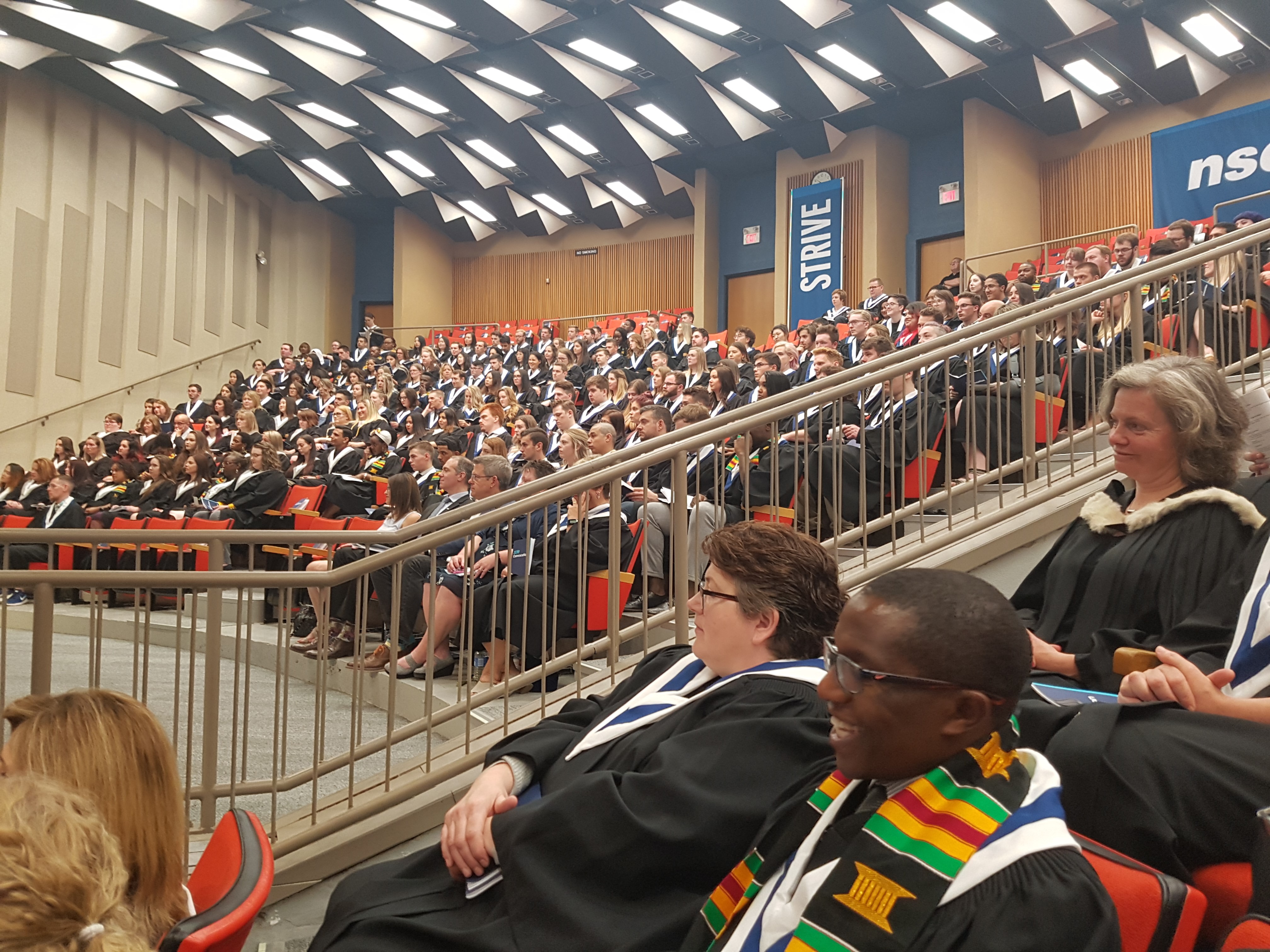
Nova Scotia Community College Convocation 2019

Post-commencement career advancement

There’s a lot of graduating going on these days and more to come.  Bravo to all the teachers and learners who are making it happen.  It’s time for celebration and reflection.  A common commencement address theme is that of the career.  My research suggests that some students don’t think seriously about their careers until long after graduation. My teaching experience is further evidence of this – despite best efforts.  It was also my workplace experience that many people don’t look ahead at their careers. Most people spend more time thinking about jobs.

Recently I asked 48 Canadian senior executives about their careers to identify barriers and enablers to career advancement.  The interviews were quite personal and very reflective.  In many cases these executives from across Canada shared their life stories with me.  Most of these people had achieved career success seemingly by all standards. Following a reasonably rigorous methodology, I identified the most common barriers and enablers to their career advancement.

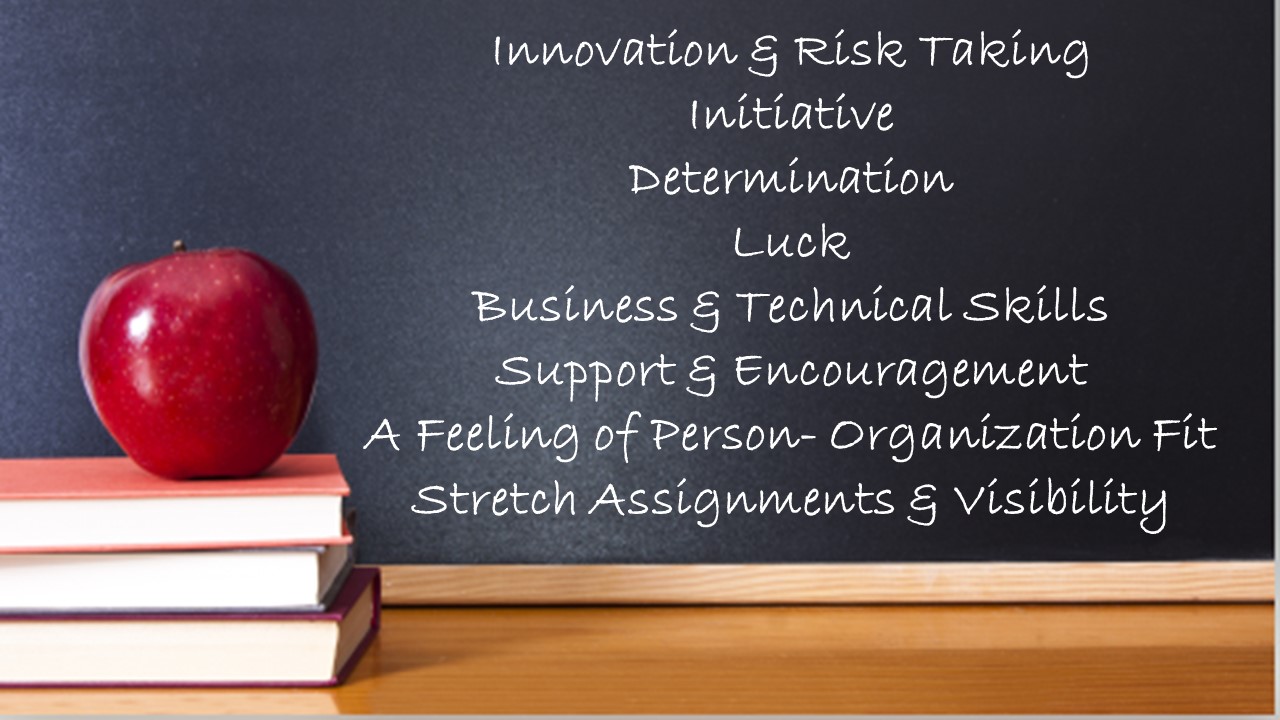
The research considered early career, mid career, and mature career phases.  A key observation from early career reflection was that careers start in school.   Executives considered their early years and education as part of their career story.  At mid career, the most common enablers to career advancement identified in this research were:

Lessons

There were fewer barriers described by participants which suggests an overall forward progression for their careers.  They typically had worked in 5.3 organizations and had 9.3 positions over their careers.  Half had lived and worked in more than one region of Canada. Of the barriers, more were described by women than men.

Career highlites for these executives came from advancing the careers of others and from paying it forward through mentorship.  Mature career reflection featured this theme of sharing career luck with others who are at an earlier career stage. There were a few laments about promotions missed, and money lost but mostly it was full circle, back to commencement, right around when it all began.

So, graduates, soon-to-be graduates, and students consider these two questions:  When did your career start?  What are your emerging career advancement enablers?  Maybe you’re experiencing post-commencement career advancement.

Reflect yes, but don’t beat yourself up

Dwelling on missed opportunities or mistakes is human nature.  A colleague recently lamented that she had left a great job to find a better one, only to realize that the grass was much greener in her original position.  She repeatedly regretted her decision and in some ways was paralyzed by it.  Researchers have found that obsessing over regrets has a negative impact on mood and sleep, can increase impulsivity, and can be a risk factor for binge eating and misusing alcohol (Taitz, 2019).

Abstract lights

Participant memories about negative career experiences were quite clear – even those long ago.  Reflection should be positive.

When asked about career regrets in a study of Canadian technology executives the most common answer was denial of negative reflection, “Oh I don’t dwell on  the past” (Fauteux, 2017).  When pressed during interviews, participants described a range of regrets including assignments not pursued, transfers not accepted, promotions not lobbied for, and other moments in time that could have been (better).  Their memories were quite clear about decisions made long ago.  No doubt you have some career regrets, I do! Its important not to let them get a hold of you.

Psychologists suggest that in order to avoid regret spiral you need to interrupt your negative thought pattern and look to the positive.  Taitz, 2019 describes this as interrupting your obsessing and treating yourself like your ideal mentor would.  Don’t beat yourself up – practice self compassion.  Her science explains once again what we know intuitively but sometimes can’t put into practice – see the sliver lining.  Life long learners who use reflection may know this best – there is positive value in every experience.

Kintsugi is a Japanese art which literally translated means “golden repair.” It is a philosophy of repairing broken things, including imperfections which are considered part of an item’s history.  So, life long learners, take time to reflect, look for the positive in every experience, and repair the broken thing(s) which are part of your career.


A Shout Out to Women at Work

There’s no denying that women face more barriers in the workplace than do men.  On International Women’s Day it’s appropriate to pause and think about what that means and what we should do about it.  On balance women are paid less than men for the same work.  They need to do more at work to advance their careers.  They put up with more crap than men – mostly crap that comes from men. Through it all they persevere.

As a society we are slowly marching towards a day when the playing field for men and women will be level.  Sadly, that day, when we reach parity, won’t happen in my lifetime. But it may happen during the lifetime of my grandson, who I hope will grow up to advocate for women – to be a feminist.  I maintain this hDream Job Green Road Sign With Dramatic Clouds and Sky.ope, and I take this position, in part because I had the privilege of listening to the life stories of men and women from across Canada as part of a research project which I undertook a couple of years ago.  I learned that all of us face barriers and enablers to career advancement – mostly barriers.  I also learned, by listening, that women face many more barriers than do men.  We don’t seem to make it any easier for them, but we should. We should give them a push and we should feel no shame in that. We should be proud to do it.  Taking proactive steps to right a social wrong is only a good thing.  Moreover, it’s a smart thing.  All evidence points to the fact that diversity in organizations, including as it relates to gender, leads to better decision making and better overall business results.

As part of my research I met with senior leadership teams from several Canadian organizations and, in group meetings, discussed the under representation of women in senior positions.  I also offered a range of solutions which might help them to change the mix – to increase the representation of women in their organizations.  Most of the leadership teams I met with, like in many organizations around the world, were predominantly male.  Most of them politely acknowledged that the gender gap existed but did not take up the invitation to adopt any of the solutions offered.  Some of them did, but they were by far the exception.  My interpretation of the overall conclusion from these executive team meetings was a message, something like, “that’s interesting, we’re in good shape, thanks for coming out.”  Really?

International Women’s Day is a good time be reminded of the realities of our workplaces and the careers of women.  They face barriers.  We all need to understand that and do something about it.  We should seriously consider measuring gender diversity and setting targets for more balance.  We should figure out how to deliberately change the mix and increase the representation of women, especially in senior positions.  Hopefully this shout out to women at work will contribute to that shift, that positive change, and nudge us in the direction of parity.


An Industry Life Gone Too Soon

I was reminded this week of what it takes to build an industry.  It was an unfortunate collision of academic theory and a real-life story of someone special leaving us too soon.   Industries go through life cycles, from introduction to decline, and a major force of industry growth is the production and diffusion of related knowledge (Grant et al, 2015). Growth Curve

Many textbooks feature images which illustrate industry or product evolution over time, sometimes called growth curves.  The similarity of these growth curves to the cycle of human life was made abundantly clear this week with the passing of an information technology icon.  Rod Wark was a Nova Scotia leader with a global reputation for his significant contribution to the sector’s growth.  He was an early adopter, an innovator, and obsessed with quality.  He led many individuals and organizations through the IT sector’s introduction, growth, and maturity.

Rod Wark significantly influenced the lives of more than 13,500 workers (ICTC, 2015) in Nova Scotia’s IT sector.  But the IT sector is special because of the multiplier effect it has on the economy by enabling the success of other sectors.  Rod Wark made a significant contribution to the growth of the IT sector, its people and companies, but he was also a profound influence on the growth of a much larger business community.  He was a builder, who’s impact should be celebrated and used as a lesson for many, long into the future.

Weak Ties, Clique Ties, Social Capital, and LinkedIn: What’s with all that?

Social capital is about relationships and your network and how they can help you to get ahead. Right? But what kind of relationships help you the most and where does LinkedIn fit in? Let’s think about that.

Social capital is considered to be any aspect of social structure that creates value and facilitates the actions and objectives of participants in that structure. Social network theorists dub the “ego” as the focal person in a network who is linked to “alters” in that same network and they measure the strength of the links as weak ties or clique ties. Weak ties would be infrequent and lack intensity or emotion. Clique ties are much stronger and would generally involve friends, advisers, and co workers. It’s the weak ties that form the bridges which connect cliques and form your social network.

Ultimately its the resources made available through these networks that contribute to your social capital. Access to information and visibility would be good examples of these resources. Your network, extended through weak ties, gets you access to these resources. Research suggests that weak ties are just as likely to contribute to a person finding a job or finding their next assignment. Clique ties are more likely to be sources of career sponsorship. They are much more intense but are limited in their reach. Given that we all have limited energy it would follow that the weak ties can be more valuable than clique ties. They’re the ones that extend your network.

So where does that leave us with our basic question about LinkedIn? Well here’s a thought. If you want to increase your social capital you need to build your social network and a great way to do that is by developing more ties, even weak ones, as would come from a tool such as LinkedIn. Of course you need to do much more to develop your social capital but making LinkedIn part of your plan makes a lot of sense, and not just because the good people at LinkedIn want you to think that way.

Ties 3